
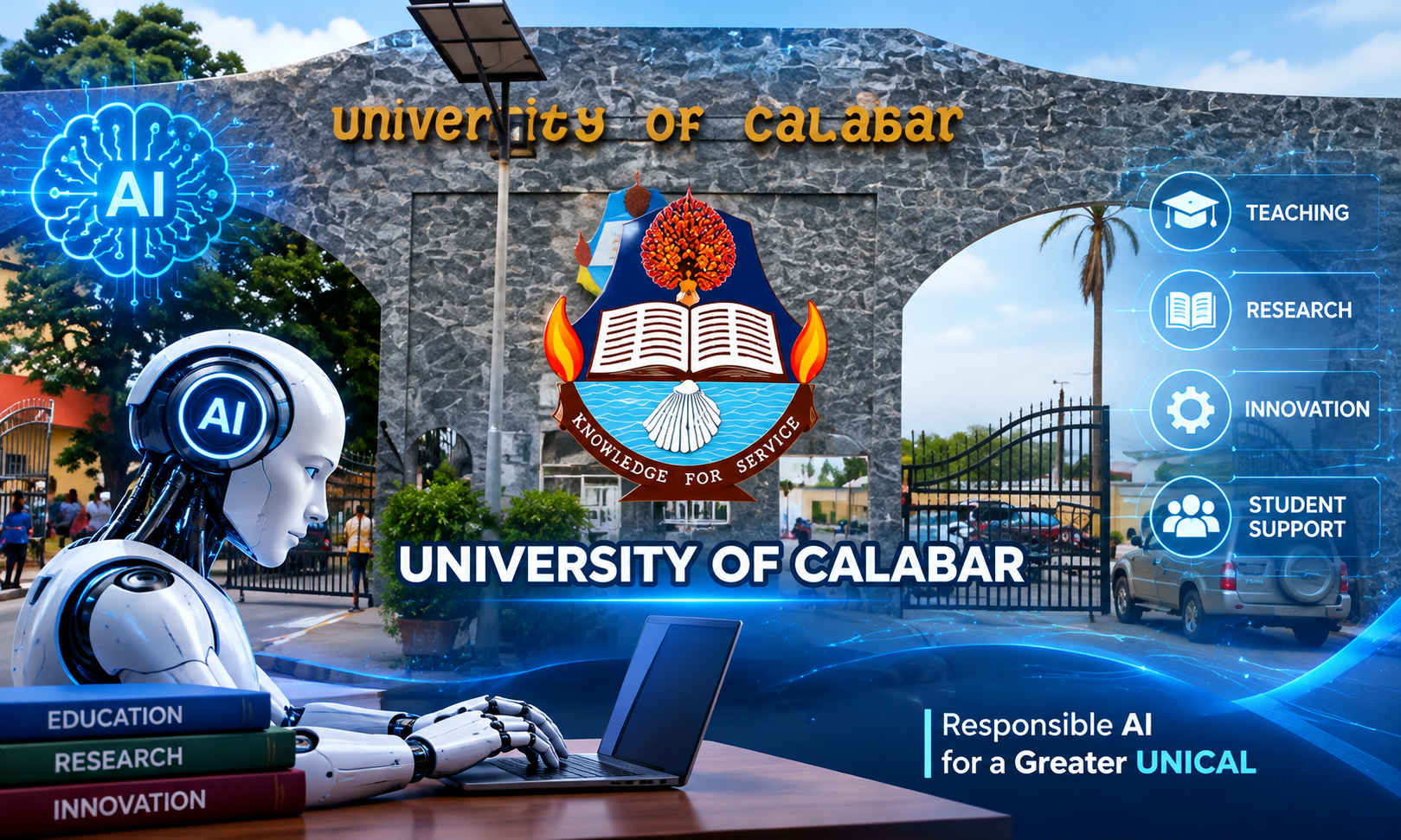
The University of Calabar (UNICAL) has introduced an Artificial Intelligence (AI) Policy for 2026–2031 to regulate the responsible use of AI in teaching, research, academic assessments, and administrative activities.
The policy provides guidelines for the ethical, secure, transparent, and responsible development, procurement, deployment, and use of artificial intelligence across the university.
According to the policy document, the framework places human accountability at the centre of AI governance, stating that while AI may support human work and decision-making, it must not remove responsibility from the people involved.
The Vice-Chancellor of UNICAL, Professor Offiong Efanga Offiong, said adopting AI presents an opportunity to strengthen the university’s teaching, research, innovation, community service and administrative functions. However, he stressed that technological advancement must go hand in hand with responsible use.
UNICAL Introduces Four AI Categories for Academic Work
Under Sections 9.0 and 18.0 of the policy, the university has established four categories for AI use in academic assessments, examinations, dissertations and course assignments.
The categories specify the extent to which students may use AI when completing academic work.
1. Class AI-0: Prohibited
AI use is strictly prohibited under this category. Students must complete the work entirely on their own, without artificial intelligence assistance.
Examples include closed-book examinations, designated in-person competency tests and invigilated certifications.
2. Class AI-1: Limited Assistance
This category permits basic preparatory assistance, such as brainstorming, checking spelling and grammar, generating queries, and explaining concepts.
However, AI must not compose the core analytical arguments or main narrative of the student’s work.
3. Class AI-2: Assisted Production
Students may use AI more extensively under this category, including for restructuring drafts, refining code, creating data visualisations, and assisting with translation.
However, students must verify AI-generated content and disclose their use of AI as required by the policy.
4. Class AI-3: AI-Integrated
AI is an explicit and required component of the academic or research methodology being assessed.
Examples include AI model tuning, synthetic data evaluation, prompt engineering analysis and the development or evaluation of autonomous agents.
The policy states that every assessment and course deliverable must have a clearly communicated AI-use classification so students understand which forms of assistance are permitted.
Apart from regulating AI use in academic work, the policy establishes four institutional risk levels for software, systems and algorithms used on behalf of the university.